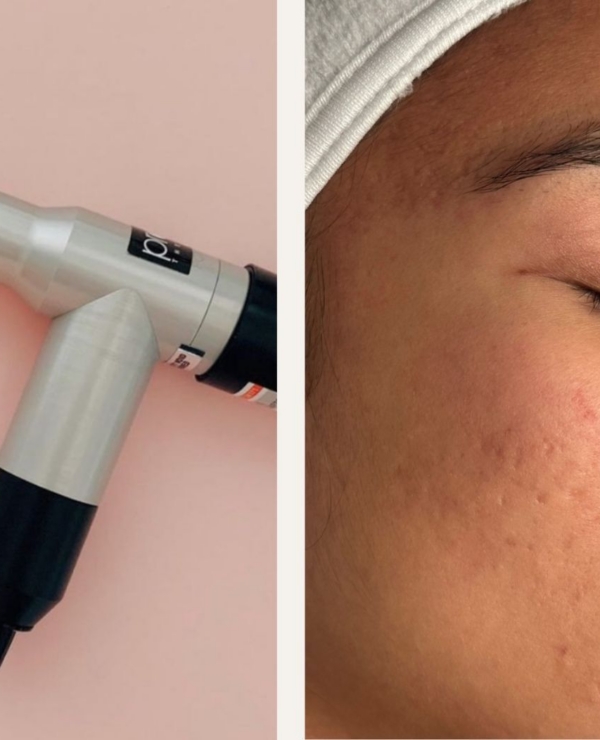
Procell microchanneling is a treatment that creates thousands of tiny, uniform channels in the skin’s outer layer to trigger new collagen and elastin, then delivers a growth factor serum through those channels to support the healing process. It’s often grouped with microneedling, but the two work differently, and that difference is why microchanneling tends to come with less irritation and less downtime. This guide covers how it works, what’s actually in the serum, what a session feels like, and who it’s a good fit for.
Key Takeaways
- Procell microchanneling uses a linear stamping technique that creates evenly spaced, fixed-depth channels, unlike microneedling rollers or pens, which drag and can tear the skin.
- The treatment pairs with a serum containing bioengineered growth factors, cytokines, and DNA repair enzymes in a hyaluronic acid base. No stem cells, animal products, or human tissue are involved.
- Most people notice some improvement in skin texture within 24 hours, but real collagen remodeling develops over several weeks and typically requires 2 to 6 sessions.
- It’s considered safe for all skin types and tones, including skin that’s acne-prone or sensitive.
- It’s not recommended for anyone who is pregnant or nursing, has an active immune-suppressing condition, or has used Accutane in the past two years.
What Procell Microchanneling Actually Does
Skin renews itself constantly, but that renewal rate slows down with age. Collagen and elastin production drop, and the outer layer of skin gets thinner and duller as a result. Microchanneling works by creating a controlled, minor injury response in that outer layer. A handheld device presses hundreds of thousands of microscopic channels into the skin. Your body reads that as a small wound and responds the way it always does: by ramping up collagen production to repair it.
Because the channels are so small and so consistent, this happens without cutting into deeper living tissue. That matters. It means the treatment can trigger real repair without the extended redness, swelling, or peeling that comes with more aggressive resurfacing procedures.
The result, over time, is skin that looks smoother, firmer, and more even in tone. People use it for fine lines, acne scarring, hyperpigmentation, stretch marks, and general texture concerns.
Microchanneling vs. Microneedling: The Real Difference
If you’ve heard of microneedling, you might wonder why microchanneling needs its own name. The distinction comes down to how the channels are created.
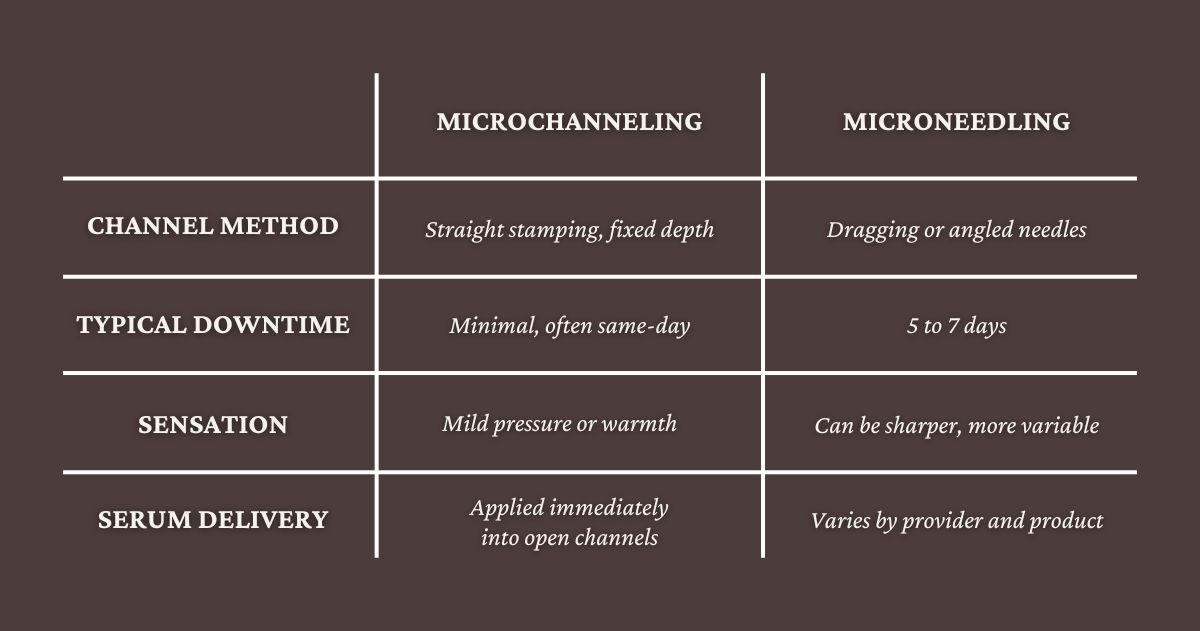
Traditional microneedling tools, whether rollers or pens, typically drag or angle the needles across the skin. That can create irregular, torn channels rather than clean ones, which is part of why microneedling often comes with 5 to 7 days of visible downtime.
Procell’s device uses a linear stamping method instead. It presses straight down and lifts straight back up, over and over, creating uniform channels at a fixed depth. Nothing drags. Nothing tears. The tips also cover more surface area per pass, which is part of why sessions move faster and why most people report only mild, temporary discomfort rather than lingering pain.
If you’re already familiar with dermaplaning as a gentler resurfacing option, microchanneling sits in a similar category: real results, without the harsh recovery some other treatments require.
What’s in the Serum (and Why It Matters)
The device only does half the work. Immediately after the channels are created, a specialized serum is applied so it can absorb deep into the skin rather than sitting on the surface.
Procell’s Microchannel Delivery Serum is built around three components:
- Growth factors: proteins that signal skin cells to repair and regenerate
- Cytokines: signaling molecules that help coordinate that repair process
- DNA repair enzymes: support for the skin’s own cellular maintenance
These are suspended in a hyaluronic acid base for hydration. It’s worth being direct about a common point of confusion here: the serum does not contain human, animal, or plant cells, DNA, or blood. The growth factors are created from bio-engineered sources in a lab, not harvested from any living donor. This formulation has been used in professional skincare settings for over a decade.
As skin ages, it naturally produces fewer of these signaling proteins on its own. The serum is designed to supplement what the skin can no longer reliably make, which is part of why the combination of microchanneling and the serum tends to outperform microchanneling alone. A randomized controlled trial published through the National Institutes of Health found that adding a topical growth factor treatment to microneedling led to measurably better improvements in skin texture and hydration than microneedling by itself. The mechanism is the same idea behind Procell’s serum: the device opens the door, and the serum is what walks through it.
What to Expect During and After Your Session

A typical session starts with a cleanse, followed by the microchanneling device being passed over the treatment area. Most clients describe the sensation as mild pressure or warmth rather than sharp pain. There’s no cutting, no bleeding to speak of, and no lingering discomfort once the device stops.
Immediately after, skin will look pink or lightly flushed, similar to a mild sunburn. This is normal and expected. A few practical aftercare notes:
- Wait at least 90 minutes before applying anything to the skin, including moisturizer
- Skip strong actives like retinoids or vitamin C for about 24 hours
- Expect a “tight” feeling in the skin for the first day, which settles as it heals
Because the treatment does trigger a genuine healing response, pairing it with support for lymphatic flow can help. At Sacred Hour, our lymphatic drainage team is the largest certified group in Ohio, and clients often find that adding lymphatic drainage work around a microchanneling series helps swelling and inflammation settle more comfortably between sessions. It’s one of the advantages of getting this treatment somewhere that offers more than just the facial itself.
Most people need 2 to 6 sessions spaced several weeks apart to see the full effect, depending on what they’re treating. Fine lines and general texture tend to respond faster than deeper scarring or significant laxity.
Frequently Asked Questions
Does Procell microchanneling hurt?
The sensation is typically described as mild pressure or warmth rather than sharp pain, since the channels are created with a straight stamping motion rather than dragging or cutting. There’s no lingering discomfort after the session ends, though skin may feel tight or mildly sensitive for a day or so.
How many sessions will I need to see results?
Some improvement in skin texture is often visible within 24 hours, but real collagen remodeling takes several weeks to develop. Most people need 2 to 6 sessions, spaced weeks apart, for noticeable and lasting change. Deeper concerns like acne scarring or significant wrinkles typically need more sessions than general dullness or mild texture issues.
Is Procell microchanneling safe for all skin types?
Yes. Because it’s minimally invasive and doesn’t cut into deeper skin layers, it’s considered safe across all skin tones and types, including skin that’s acne-prone or reactive. It’s not recommended for anyone who is pregnant or nursing, has an immune-suppressing condition, has used Accutane in the past two years, or has a stainless steel allergy.
What should I avoid after treatment?
Wait at least 90 minutes before applying any products, including moisturizer. For the first 24 hours, skip strong actives like retinoids, vitamin C, and exfoliants, since skin is more sensitive than usual during that window. Light hydration and sun protection are the priorities in the days that follow.
The Bottom Line
Procell microchanneling gives skin a real reason to make new collagen, using a method built to minimize trauma and downtime along the way. Every skin type responds a little differently, so the best next step is a conversation. Contact Sacred Hour to talk through whether Procell fits your skin goals, and we’ll help you map out a session plan.